
Celebrating 10 Years of Surgical Leadership with Bryan Clary, M.D., M.B.A.
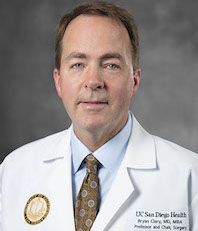
Bryan Clary, M.D., M.B.A., is a professor and chair of the Department of Surgery in the UC San Diego School of Medicine. He recently celebrated his 10th anniversary as chair and shared his path to UC San Diego, accomplishments and hopes for the future.
December 18, 2025 | Interview by Brittany Fair and Samantha Phan
What led you to UC San Diego?
I was recruited to the role of chair of the Department of Surgery in the UC San Diego School of Medicine in 2015. Prior to this, I served as a faculty member at Duke University with a clinical practice in complex hepatobiliary surgery, a translational science laboratory focused on novel therapeutics for metastatic colon cancer, and a portfolio of administrative roles, including program director for the general surgery residency. I felt fulfilled, and my family and pets were happy living in North Carolina.
However, I began considering how I could be more impactful in my career and was interested in leading an academic department of surgery. I enrolled in an executive M.B.A. program at Duke University’s Fuqua School of Business to enhance my leadership and managerial skills and began to explore potential chair of surgery opportunities.
As a native of Imperial County and an undergraduate alumnus of UC San Diego (Third College ’87), I was beyond excited when the chair of the Department of Surgery position opened at UC San Diego. I was elated when I was chosen to lead the department while serving communities that were dear to my heart.
What was it like finally stepping into this leadership role?
While my portfolio of experiences as a Duke faculty member provided me with a solid understanding of how to succeed in the three missions of academic surgical departments (clinical care, education and research), my new role as chair was still a substantial leap in responsibility. I had to lead faculty in specialties/ subspecialities that I was not completely familiar with, as well as earn the trust and respect of my faculty, trainees, operating room nurses, staff and those that I would report to.
I remember showing up on my first day at the Hillcrest campus and thinking, “what do I do now?” Indeed, there was no “driver’s manual” that would tell me how to operate this complex “vehicle” of being a good chair. Funny enough, over 10 years later, I worked with other surgery chairs from across the country to draft the American College of Surgeons Surgical Chairs Playbook!
What did the department look like when you first became chair?
When I became chair in 2015, the department included many specialties, such as neurosurgery and urology, that were typically independent departments at most other academic centers. We also had a few divisions that were underdeveloped — they were not meeting the needs of our communities nor the expectations of a world-class institution. Lastly, the department was a bit financially challenged, which did not reflect the great work of our team.
What goals did you initially have for the department? How have you fulfilled those goals?
I focused on our primary missions to deliver exceptional patient care, provide premier training and educational programs, and conduct impactful research that brings forth a better tomorrow. I also wanted the department to be a place where people feel respected and part of a team that is tangibly making a difference in the world.
While I am biased, I believe that our team members have delivered in spades on every one of these goals and aspirations. While I helped set the direction, these successes were ultimately made possible by the exceptional division leaders, faculty, trainees and staff in the department, as well as our multidisciplinary partners.
How has the department changed over time?
The department has changed substantially over the past 10 years. We’ve hired more than 70 new faculty and grown our clinical, research and training programs. Our faculty are highly visible nationally, with many serving in executive roles of their respective associations and societies. We also added the Division of Surgical Sciences to serve as a home for non-clinical scientists. Importantly, the culture of the department has evolved positively, driven in part by a robust communications platform to inform and highlight the efforts and accomplishments of our team.
Lastly, we’ve expanded our clinical facilities immensely, which has been critical to our success, including the opening of Jacobs Medical Center, Koman Outpatient Pavilion and McGrath Outpatient Pavilion; new partnerships with Eisenhower Health, El Centro Regional Medical Center and Palomar Health District of North San Diego; and the purchase of East Campus Medical Center (formerly known as Alvarado Hospital).
What is your greatest accomplishment as chair?
While it may sound cliché, “I” have accomplished nothing, but “we” have accomplished much. I am most proud of the extraordinary team that we have assembled through both recruitment and the maturation, development and retention of long-standing team members. I am truly amazed every day by the talents, dedication and commitment of our personnel.
What are some of the challenges you have faced over the years?
There is no shortage of challenges in our complex academic environment. From 2015 to 2020, our department grew with increased financial support that allowed us to transform our research and educational programs. Then a once-in-a-century pandemic hit…
The response of UC San Diego Health to the pandemic was a true marvel. Members of the department were integral, caring for COVID-stricken patients, minimizing disruptions in care for non-COVID conditions, and facilitating an early return to education and research programming. I honestly cannot praise our faculty and team members enough for their contributions during that time.
Today’s challenges include state and federal funding and regulatory disruptions, the rising costs of delivering care, among others. However, I have no doubt about our ability to weather these challenges and whatever the future brings.
Looking forward, what comes next for the department? What are your upcoming goals, initiatives or ideas?
Although the principal objectives of the department will always remain the same, we are growing in numerous ways. For example, we’re adding new research programming across many divisions, expanding and improving our educational programs, and bringing new technologies into the clinical arena. We have an obligation and desire to further expand access to our unique and award-winning clinical programs to even more patients throughout our region and beyond.
Is there anything you would do differently?
I have certainly made my share of mistakes over the past 10 years. There are situations where I wish I could have a “do over,” but one thing that I would not change is the decision to join the team at UC San Diego. The last 10 years have been immensely fulfilling, and together we have accomplished so much that has tangibly and substantially improved the lives of patients throughout our region.